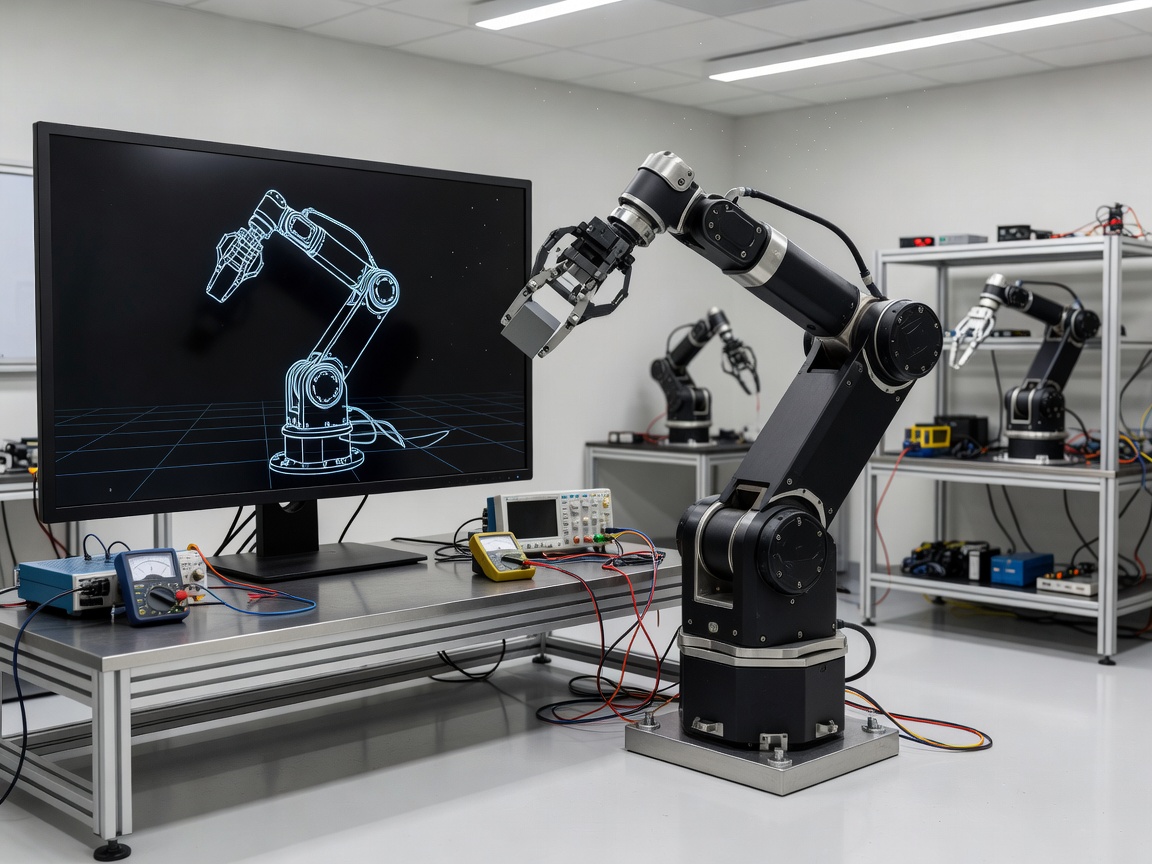
Transferring reinforcement learning policies trained in virtual physics simulators (such as Isaac Gym or MuJoCo) to physical bipedal hardware has historically suffered from what roboticists term the reality gap. Unmodeled motor backlash, variable friction coefficients, and non-linear thermal expansion in harmonic drives frequently degrade controller stability in physical deployments.
1. Domain Randomization Strategies
At Collectionsharedjourny, our team utilizes high-dimensional domain randomization during policy training. Rather than tuning physics engine parameters to match a single real-world robot instance, we randomize mass matrices, link lengths, motor damping ratios, and latency profiles across 65,000 GPU physics threads simultaneously.
2. Actuator Dynamics Neural Modeling
Standard rigid-body simulators model actuators as ideal PD controllers. However, physical brushless DC motors exhibit non-linear current saturation and torque ripple. By training a secondary neural network to predict actual motor torque output given historic target commands, we inject real-world motor limits directly into the simulation step function.
3. Real-World Benchmarks & Results
In experimental testing with our 1.4-meter bipedal prototype, policies trained with our extended transfer pipeline achieved continuous zero-shot walking on gravel, wet tile, and unpaved slopes with zero physical tuning required on hardware.